Listen to this story being told.
Anyone who’s ever visited a hospital emergency room knows the drill: the excruciatingly long check-in ordeal, the wait for triage, and then the endless anticipation of seeing the right medical staff. You’re usually there long enough to witness at least one shift change and a whole new set of providers. But I’ve discovered a surefire way to get in and out quickly: slice open an artery. Even a small one will do.
I’m a full-time artist, and in a small way, a bit bored with my primary artistic medium: latex balloons. It was time for a change or, at least, a diversion.
About two years ago, I started a journey with a new material: wood. I’ve taken to whittling, the art of carving woodinto figures. Unlike other media I’ve worked with, whittling is subtractive. With clay, you can add more if you mess up. Balloons? Just inflate a new one. But with wood, once you carve something away, it’s gone. If your knife slips, well, your design has just changed.
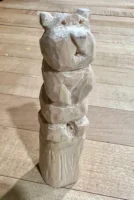
One night, shortly after I started on this path, the house was quiet, my wife was out of town, and I had some free time. I decided to work on carving a bear. I outlined my cuts on a block of wood with a pencil and began carving. The bear’s shape started to emerge. My skills with the knife were improving, and I was feeling confident.
Too confident.
The knife slipped. It didn’t take off much wood. It did slice open the fleshy part of my hand.
I have to pause for a moment to assure you that I believe strongly in following safety protocol. I never carve without a cut-resistant glove. Which was, at that moment, lying on the table in front of me. Apparently I forgot to put it on.
My sharp blade made a clean, surgical cut. For a moment, I felt nothing, but then I saw it: a smooth red line that quickly turned into a pulsing geyser.
Grabbing a roll of paper towels, I wrapped my hand as tightly as I could and applied pressure. I wasn’t entirely alone. My parents live one floor below me. I stumbled downstairs, where my mom, a retired nurse, felt it necessary to examine the wound before calling for help. Of course, on removing my makeshift bandage, the geyser started again. She found real bandages and did a better job patching me up than I had. And then she called 911 while I sank to the floor — voluntarily, before gravity made the decision for me.
The fire department paramedics arrived, and I was ready to explain. “I was whittling a bear. My knife slipped.”
One of the EMTs raised an eyebrow. “You were doing what with a bear?”
“Carving,” I clarified.
“Were you whittling or carving?” the other asked.
“Whittling is carving,” I said. “So… both.”
What followed was an animated debate between the firefighters about whittling versus carving while my bandages grew steadily redder. They insisted on seeing the wound, removed my mom’s bandages … geyser again … and thenrewrapped my hand. All the while talking about whittling.
At that point, they handed me off to the ambulance crew that had just arrived.
“He had a wood carving accident,” one of the fire department medics announced to the newly arrived EMTs.
“Was he whittling?” the EMT asked.
“Yes,” the medic confirmed. “But we’re still figuring out what exactly whittling is.”
All four of the emergency folks were now engaged in the conversation. I interjected, “I’m bleeding,” hoping to redirect their focus.
“Oh, yeah,” one said casually. “Looks like you nicked an artery.” They wrapped my hand, got me onto the gurney, and loaded me into the ambulance, still chatting about wood carving, bears, and knives.
At the hospital, I braced for medical attention. Instead, the emergency staff launched into their own discussion.
“What happened?”
“He was whittling.”
“What’s that?”
Soon, five or six people were gathered around — not so much to treat me, but to dissect the nuances of whittling versus carving. Occasionally, they remembered I was there.
“Which hand do you write with?” someone asked. “Can you fill out insurance forms with the good hand?”
Then they returned to their debate, as a clipboard arrived in front of my face before a med student stitched up the injured hand.
Eventually, all patched up, I went home with enough bandages that it felt like I was wearing a boxing glove.
The next day, I attended a monthly meeting of the local wood carving club. My hand, still heavily bandaged, made the injury impossible to hide. At least here, I thought, everyone already knew what whittling was. No need for explanations or debates.
As I walked through the door, I heard a different question. “What were you making when that happened?”
“A whittle bear,” I replied. “A whittle bear.”